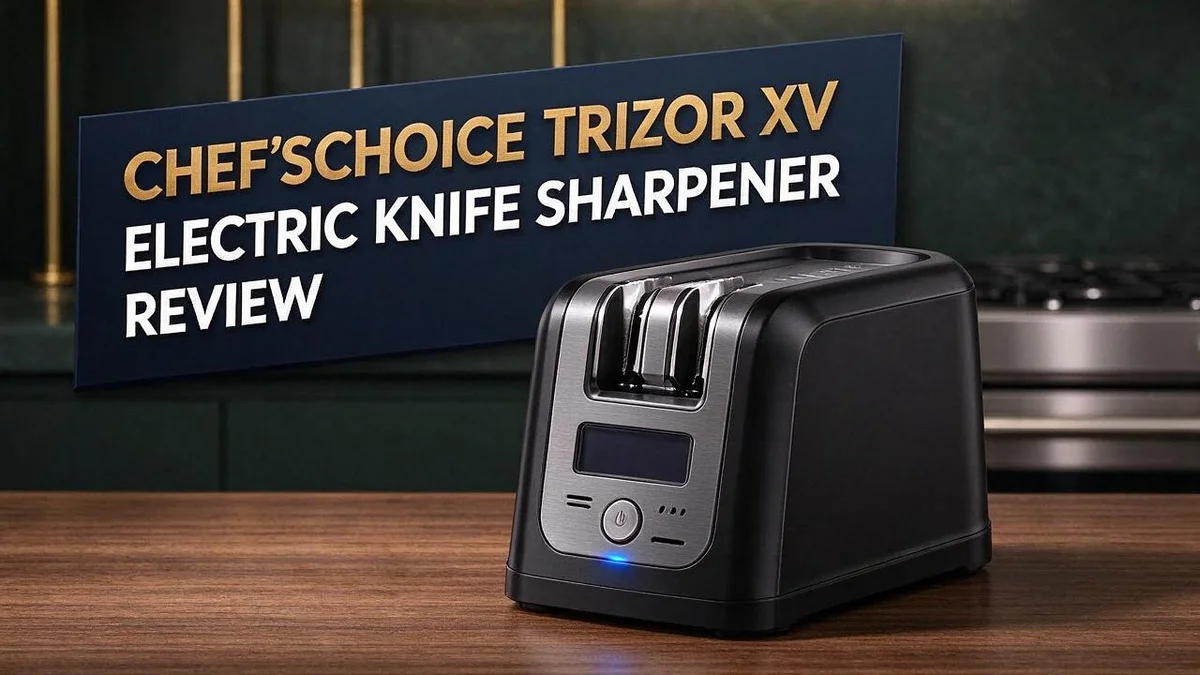
Chef’sChoice Trizor XV Electric Knife Sharpener Review 2026
Dull knives make every meal harder to prepare. Many home cooks want a fast fix that actually works.
The Chef’sChoice Trizor XV is an electric knife sharpener built for that job. It converts a 20 degree factory edge into a sharper 15 degree edge. It uses diamond abrasives and a rotating five stage system.
It handles Asian style knives, cleavers, and serrated knives too. Many owners say it creates a very sharp edge with little skill needed.
Still, this model has some trade offs. It removes a fair amount of metal. Some users see inconsistent results, and a few notice hairline scratches on their blades.
In this review, you will learn how the Trizor XV performs. You will also see how it compares with rivals like the Work Sharp Ken Onion Edition. Let us find out if it suits your kitchen.
In a Nutshell
-
Fast results for busy cooks: The Trizor XV sharpens quickly. You do not need much skill to get started.
-
Five stages in one unit: The rotating system restores, repairs, polishes, and sharpens your blade. Tungsten carbide and ceramic stages do the work.
-
A sharper starting angle: The machine turns a 20 degree factory edge into a 15 degree edge. This change gives you a keener cut from the first use.
-
Metal removal to watch: This model removes a lot of metal. Your knives may lose some length over time.
-
Results can vary: Some owners see a V shaped edge. Others spot hairline scratches on the blade.
-
Best for careful owners: Anyone who wants steady results should check each blade often. Frequent checks help you protect your knife collection.
Build Quality and Design

- CONVERT YOUR KNIVES: Ideal for converting traditional 20-degree factory edges of household knives...
- DIAMONDS: Advanced stropping stage and 100 percent diamond abrasives for sharpening straight edge...

Last update on 2026-10-29 / Affiliate links / Images from Amazon Product Advertising API Some of the links on this website are affiliate links, which means that at no additional cost to you, I earn a commission if you click through and make a purchase. I only recommend products and services that I believe will add value to my readers. Thank you for your support!
The Chef’sChoice Trizor XV has a plain gray body. It looks practical and fits easily on most counters. The design puts function first.
Inside, the first stage uses diamond abrasives. Diamond is one of the hardest materials available. It cuts steel quickly and gives each pass a firm bite.
The other stages use tungsten carbide and ceramic. Each stage handles a different part of the job. Together, they move the blade from rough work to fine polish in one unit.
The design also has a trade off. The guides hide the blade while it runs through the machine. Some critics say this makes it harder to see your progress. Less visibility can make accuracy harder to judge.
Your grip matters. Hold the handle firmly and keep the blade steady. Pull the knife through each slot with even pressure. A calm, slow pace gives you more control.
Some users report hairline scratches on the blade surface. Slow and even strokes may help reduce this problem. Checking the edge after each pass also helps you catch marks early.
Because the unit is electric, you need a nearby outlet. Place it on a flat, stable surface. This keeps the machine steady during use.
Good design starts with simple habits. Clean the slots after each session. Wipe the blade dry before you store it. These small steps protect both the machine and your knives over time.
Sharpening Performance and Edge Quality
Sharpness is the real test. A good knife should slice a ripe tomato without squashing it. Most home cooks can reach that point in one session.
Edge quality shows up in small kitchen moments. A keen blade grabs a sheet of paper cleanly. It also glides through onions with less force.
Run a simple paper test after each stage. Slice a sheet of printer paper in one smooth pull. If the cut snags or tears, the edge needs more work.
A tiny burr can hide on the edge. Electric sharpeners remove metal quickly, so a thin wire edge may form along the blade. Light strokes on the finest stage help remove it.
Edge retention matters just as much as the first cut. A blade that stays keen for weeks saves time. Gentle honing between sessions can keep the edge sharp longer.
Blade thickness changes the outcome too. Thin blades respond fast, so they need fewer passes and less care. Thicker blades take more time, and they may need extra checks for an even bevel.
Match the edge to the job. A paring knife often works best with a very fine edge. A heavy cleaver can handle a slightly bolder edge that resists chips when chopping bone or frozen food.
Watch for uneven wear. Hold the blade up to a light and look at the edge. Shiny patches or dull spots show where the stroke missed. Adjust your next pass to even things out.
Small habits lead to steady edges. Mark the blade with a marker before sharpening. When the ink wears off evenly, the bevel is forming well. Simple checks like this build confidence over time.
Overall, edge quality depends on patience and attention. Speed helps busy cooks, but a careful eye produces the best cutting results. Good technique turns a fast machine into a dependable tool.
Blade Compatibility and Edge Angles
Blade compatibility depends on the knife style, the steel, and the thickness of the spine. Check each knife before you start. Thin blades need light pressure. A thin spine flexes under heavy force, so let the abrasives do the work. Hold the knife at a steady angle from start to finish.
Steel type changes the result. Hard steel holds an edge longer but takes more time to sharpen. Softer steel sharpens quickly but dulls sooner. Test one blade first to learn how your knife behaves.
Most Western kitchen knives start near 20 degrees. Thinner Japanese style blades often start closer to 15 degrees. Measuring first helps you pick the right stage.
Edge angle matters more than speed. A very low angle on a sturdy blade can chip the edge. Thick heavy knives handle a wider angle better.
Cleavers need a different approach. Their thick, heavy blades can take more pressure, so you may use a firmer grip. Check the edge after each pass.
Serrated knives need extra care. Repeated passes can flatten the scallops, so use fewer passes and watch the teeth closely.
Quick angle check: Color the edge with a permanent marker. Run the blade through one stage. Marker removed from the bevel shows where the abrasive touches. If it disappears only near the tip, adjust your angle.
Think about your daily tasks too. A knife for hard squash needs a sturdier edge than one used for soft herbs. Plan your stages around that difference.
Keep a simple log. Write down each knife, its starting angle, and the stage you used. Over time, you will know which blades need a gentle touch.
Some knives may not suit this machine at all. Very soft blades or ultra thin Japanese knives can lose too much metal fast. Choose a manual stone for those.
Top 3 Alternatives
If you want a different option for sharpening your knives, these three alternatives may fit your needs. Each one offers a unique way to keep your blades ready for daily cooking.
Work Sharp Culinary E5

- RESTORE AND REFINE ALL IN ONE MACHINE Sharpen a dull edge and then hone it keen in the same unit...
- HANDLES YOUR FULL CUTLERY LINEUP Chef, santoku, paring, and utility knives all get a consistent...
Last update on 2026-10-29 / Affiliate links / Images from Amazon Product Advertising API Some of the links on this website are affiliate links, which means that at no additional cost to you, I earn a commission if you click through and make a purchase. I only recommend products and services that I believe will add value to my readers. Thank you for your support!
The Work Sharp Culinary E5 works well for home cooks. It uses a guided system, so you set the angle and the guide keeps your blade steady. It has diamond abrasives that sharpen steel quickly. Beginners can get a clean, sharp edge with very little practice.
Work Sharp Ken Onion

- PROFESSIONAL POWERED EDGE IN MINUTES: Motorized flexible belt hugs the blade to sharpen and hone in...
- FULLY ADJUSTABLE ANGLE, 10 TO 35 DEGREES: Adjust the belt angle for precision sharpening from...
Last update on 2026-10-29 / Affiliate links / Images from Amazon Product Advertising API Some of the links on this website are affiliate links, which means that at no additional cost to you, I earn a commission if you click through and make a purchase. I only recommend products and services that I believe will add value to my readers. Thank you for your support!
The Work Sharp Ken Onion suits people who want more control. It has an adjustable guide for different edge angles. Many users choose it for unusual blades and tools. You can sharpen kitchen knives, pocket knives, and more with one simple setup.
Presto ProSharp

- Sharpen kitchen and sport knives to a razor-sharp edge fast and economically.
- Easy 2-stage sharpening system for professional results at home on most any non-serrated blade.
Last update on 2026-10-29 / Affiliate links / Images from Amazon Product Advertising API Some of the links on this website are affiliate links, which means that at no additional cost to you, I earn a commission if you click through and make a purchase. I only recommend products and services that I believe will add value to my readers. Thank you for your support!
The Presto ProSharp keeps things simple. It uses a three-stage process for coarse, fine, and polished edges. You pull the blade through the guided slots. Very little effort is needed, so it is a good choice for a quick touch-up before dinner.
Pick the option that matches your skill level and your knife collection. Each product above can help your blades stay sharp and ready for everyday meals.
Ease of Use and Safety
The Trizor XV feels easy to learn. Most people understand the process after just a few passes. The built in guides set the angle for you, so you can focus on smooth movement.
Your fingers need extra care during each session. Keep your fingertips well away from the moving stages. Slide the blade in with light pressure instead of forcing it.
Wear safety glasses while you sharpen. Tiny metal particles can fly off the blade. Eye protection is a simple habit that prevents painful accidents.
Power safety matters just as much. Unplug the unit before you change stages or wipe the housing. Keep the cord away from the sink and any spilled water.
Keep the sharpener out of reach of children. Curious kids may touch the spinning parts without warning. Store the unit in a cabinet when you finish.
Long sessions can warm the motor. Give the machine a short rest between knives. A cooler motor runs more evenly and lasts longer.
Choose a stable work surface before you start. A flat counter that does not slide keeps the unit still. Clear away loose paper, towels, and tools so nothing gets caught.
A bright room helps you see the blade clearly. Good light shows the blade position and reduces mistakes.
Practice on a spare blade first. This lets you learn the motion without risk. Save your favorite knife for later.
Handle the blade by its spine when you move it around. Freshly sharpened edges can cut you easily.
Safety grows with routine. Build a short checklist and follow it every time. A simple routine helps you stay alert and protects your hands for years.
Metal Removal and Long-Term Blade Care
Metal removal is the main downside of this sharpener. Every pass takes away a small layer of steel from the blade. Over time, that layer adds up.
Each session takes a small slice of your knife’s life. Removing too much metal makes the blade thinner near the edge. Thin steel can bend, chip, or flex during heavy chopping.
Here is a simple way to protect your knives. Use the coarsest stage only when the edge is truly damaged. For a normal touch up, skip it and move to the finer stages.
Use the lightest pressure possible. Let the wheels do the work. Pushing hard does not speed up the process. It only removes more steel.
Pay attention to the spine too. If the blade looks thinner after each session, the sharpener may be taking too much. Measure the blade height at the heel from time to time.
Some reviewers say results can be uneven. An uneven pass can leave a V shape along the edge. A V shaped edge cuts well at first but dulls quickly. Over several sessions, this shape can shorten the life of the knife. Check the edge shape often so you catch problems early.
Long-term care matters more than speed. Hone the edge between sessions with a light steel or ceramic rod. Honing realigns the edge and reduces how often you need the sharpener. Fewer sessions mean less metal lost.
Store your knives in a block, on a magnetic strip, or in a sheath. Loose knives in a drawer knock against each other. This contact dulls edges and nicks the steel.
Clean the blade after sharpening too. Metal dust can build up on the knife and the cutting board. Wash and dry the blade by hand right away.
Finally, rotate your knives so no single blade gets all the work. Good habits keep your collection sharp for years.
Pros and Cons
Pros
– One machine handles Western, Asian style, and serrated blades.
– Five stages let you restore, repair, polish, and sharpen.
– Diamond abrasives help bring back very dull kitchen knives.
– It saves you trips to a professional sharpening service.
Cons
– You cannot watch the blade closely while it sharpens.
– Some blades end up with a V shaped edge.
– Fine scratches can show up on the blade finish.
– Other models give you more hands on control.
Who Should Buy It
The Trizor XV suits people who feel nervous about freehand sharpening. Many home cooks avoid stones because they fear ruining a favorite blade. This machine guides each knife through set angles, which eases that worry.
Busy households with dull knives also gain a lot. When a family cooks every night, blades lose their bite fast. A short session can bring them back to work in minutes.
Cooks with a mixed knife collection fit the profile too. Serrated blades and cleavers join the list of tools it handles. Owners skip buying several specialist sharpeners for each kitchen task.
Those who accept faster blade wear should feel comfortable here. Every session removes a bit of steel, so knives wear down over time. Some buyers see that as a fair trade for speed.
Professional chefs with rare, premium knives may prefer a different route. A trusted service like Lumberjack Sharpening can treat fine blades with more care.
Skilled sharpeners who enjoy every stroke may find the machine limiting. They often want full control over angle and pressure. A manual system or a Tormek style wheel may suit them better.
Occasional cooks who use knives on weekends may not need this tool. A few light sessions each year keep most blades in good shape. A simple honing rod may cover their needs.
Gift shoppers for active home cooks can also consider it. A sharp tool helps the recipient cook faster and feel more confident. Choose it when the person already owns good knives worth maintaining.
Anyone unsure about the fit should take a simple test. List every knife you own and note how often each one needs attention. Then compare that list with the blade types this sharpener handles. If most of your knives fit, this machine likely earns a place on your counter.
Final Verdict
The short answer is yes, but with clear expectations. The Trizor XV earns its place for people who want fast edges without years of practice.
Its biggest win is convenience. You can finish a dull knife in one sitting and get back to cooking.
Still, it is not the only route. Work Sharp Ken Onion Edition suits enthusiasts who want a guided manual approach. Tormek fits those who enjoy slow, precise stone work. Lumberjack Sharpening is the right pick when you want a professional to handle every blade.
Think of the Trizor XV as a practical middle ground. It sits between a quick home fix and a full manual setup.
Within the Chef’sChoice family, the 120, 130, and 1520 models share a similar goal. Compare them side by side before you commit. Look closely at which features you will use most and which blades you own.
Your own habits matter most. Count how many knives need attention each month. If the number stays small, a home electric unit may feel like overkill. If the list grows, the time saved adds up fast.
Start with a clear goal. Write down three priorities, such as speed, edge control, and blade life. Score each option against them. The best fit often becomes clear.
Our bottom line: The Trizor XV delivers strong results for everyday kitchen knives. It works best when you accept some blade wear and value speed over precise control. If that compromise feels right, this sharpener deserves a spot on your counter.
Frequently Asked Questions
Does the Trizor XV make knives sharper than the factory edge?
Yes, it can. The machine converts a 20° factory edge to a 15° edge. A narrower angle slices through food with less force.
Do I need special skills to use it?
No, you need very little skill. The guides do most of the work, so beginners can get a usable edge quickly.
Which alternatives should I compare first?
Look at the Work Sharp Ken Onion Edition if you want a guided tool. Tormek is another name worth comparing. Chef’sChoice 120, 130, and 1520 models also share a similar goal with the Trizor XV.
Can a professional service do the job instead?
Yes. Lumberjack Sharpening handles the work for you. Sending a knife out keeps the job in expert hands, which suits rare or valuable blades.
What should I check after sharpening?
Test the edge on a sheet of paper or a ripe tomato. A clean cut shows the edge works well. If the cut tears, run the blade through the stages again or try a light steel rod.

Hi, I’m Greta Monroe, and I’m passionate about making every kitchen a place of creativity and efficiency. I’ve spent years exploring and testing kitchen gadgets, tools, and devices to help home cooks find exactly what they need. At ChefKit Blog, I share honest Amazon product reviews and practical insights on kitchen essentials that actually make a difference. From must-have basics to innovative new devices, I break down what works and what doesn’t. My mission is simple: to help you build a kitchen that inspires delicious possibilities every single day.