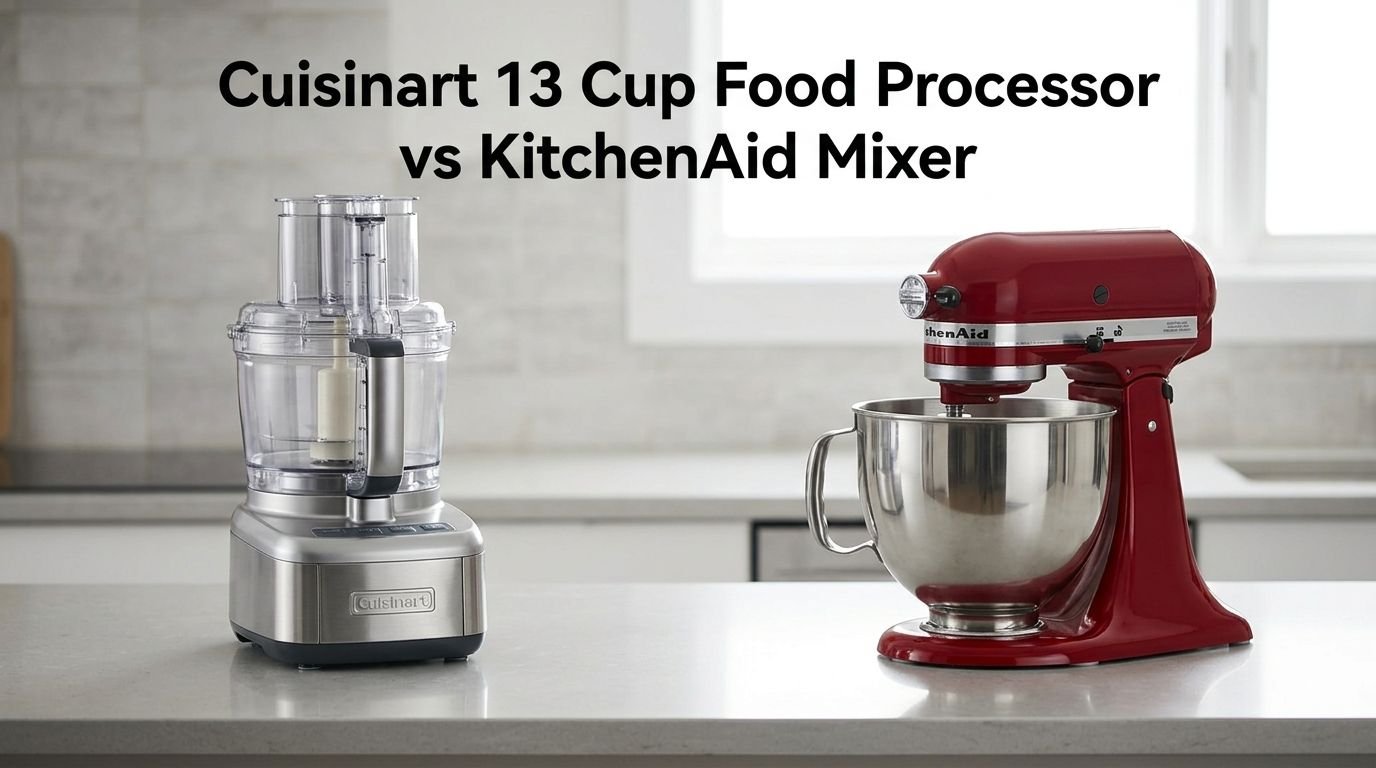
Cuisinart 13 Cup Food Processor vs KitchenAid Mixer
Choosing between a Cuisinart 13 cup food processor and a KitchenAid mixer can feel like picking a favorite child. Both machines promise to transform your kitchen experience. Both carry serious brand loyalty. And both come with price tags that demand careful consideration.
Here is the truth. These two appliances serve very different purposes, yet their functions overlap in surprising ways. A food processor chops, slices, shreds, and purees with lightning speed.
A stand mixer kneads dough, whips cream, and beats batter like a professional pastry chef. But which one gives you more bang for your buck?
Key Takeaways:
- The Cuisinart 13 cup food processor excels at chopping, slicing, shredding, and pureeing tasks. It handles vegetables, nuts, cheeses, and sauces faster than almost any other kitchen tool. If meal prep speed matters to you, this is the clear winner.
- The KitchenAid stand mixer dominates baking tasks like kneading bread dough, whipping egg whites, and mixing thick cookie batter. Its planetary mixing action reaches every inch of the bowl, producing consistent results every time.
- Budget matters in this decision. The Cuisinart 13 cup food processor typically costs less than a KitchenAid stand mixer. However, KitchenAid mixers hold their resale value better over time and often last for decades.
- Attachment ecosystems change the game. KitchenAid offers over 10 optional attachments including food processor bowls, pasta makers, and meat grinders. This turns one appliance into many. Cuisinart food processors have fewer expansion options but perform their core tasks extremely well out of the box.
- Counter space and storage should influence your choice. The KitchenAid mixer is heavy and usually stays on the counter permanently. The Cuisinart food processor is lighter but still takes up significant cabinet space with all its blades and discs.
- Many serious home cooks eventually own both appliances. They complement each other perfectly rather than compete directly.
Cuisinart 13 Cup Food Processor: A Complete Overview

- SUPERIOR FUNCTION: The Cuisinart Food Processor with 720-watt motor functions as a vegetable...
- MUST-HAVE FEATURES: The 14-cup food chopper has “on” and “off/pulse” buttons with an...

Last update on 2026-08-22 / Affiliate links / Images from Amazon Product Advertising API Some of the links on this website are affiliate links, which means that at no additional cost to you, I earn a commission if you click through and make a purchase. I only recommend products and services that I believe will add value to my readers. Thank you for your support!
The Cuisinart 13 cup food processor has been a kitchen staple for years. The model most people refer to is the Cuisinart FP-13DSV or similar variants in the 13 cup lineup. It features a 550 watt motor that handles everything from soft fruits to hard cheeses without hesitation.
The work bowl holds 13 cups of ingredients. This capacity suits families of four to six people comfortably. You can shred an entire block of mozzarella in seconds or chop onions for a large batch of salsa in one pulse.
Cuisinart includes a stainless steel standard blade, a dough blade, and adjustable slicing and shredding discs in the box. The SealTight Advantage System keeps liquids inside the bowl during processing. This is a feature many users appreciate for making soups and dressings.
The machine operates with simple push button controls. There is no complicated digital interface to learn. You get on, off, and pulse functions. That simplicity is part of what makes Cuisinart food processors so popular.
Pros:
- Large 13 cup capacity handles big batch cooking
- Multiple blades and discs included at no extra cost
- Affordable price point for the performance level
- Dishwasher safe parts make cleanup easy
- Compact footprint relative to its capacity
Cons:
- Motor can struggle with extremely heavy bread dough
- Plastic bowl may scratch or cloud over time
- Loud during operation at higher speeds
- Cannot whip air into batters or cream effectively
KitchenAid Stand Mixer: A Complete Overview

- Durable and built-to-last metal construction, with 59 touchpoints around the mixer bowl for great...
- 5 Quart Stainless Steel Bowl with comfortable handle for small or large batches, to mix up 9 dozen...
Last update on 2026-07-09 / Affiliate links / Images from Amazon Product Advertising API Some of the links on this website are affiliate links, which means that at no additional cost to you, I earn a commission if you click through and make a purchase. I only recommend products and services that I believe will add value to my readers. Thank you for your support!
The KitchenAid Artisan Series 5 quart stand mixer is arguably the most recognized kitchen appliance in the world. Its 325 watt motor uses a unique planetary mixing action. The beater moves in one direction while the shaft spins in the opposite direction. This covers 59 touchpoints inside the bowl for thorough, even mixing.
The tilt head design gives you easy access to the bowl. You get a flat beater, a dough hook, and a wire whip included with purchase. Each attachment serves a specific purpose. The flat beater handles cookie dough and cake batter. The dough hook kneads bread. The wire whip aerates cream and egg whites.
KitchenAid mixers come in over 40 colors. This matters more than you might think. Many owners proudly display their mixer as a kitchen centerpiece. The all metal construction feels premium and weighs about 26 pounds, which keeps the mixer stable during heavy mixing.
The 10 speed settings give you precise control over every recipe. Speed 1 gently folds ingredients. Speed 10 whips cream to stiff peaks in under a minute.
Pros:
- Planetary mixing action ensures thorough, even results
- Incredibly durable with many lasting 20 plus years
- Massive attachment ecosystem expands functionality
- Beautiful design available in dozens of colors
- Excellent for bread dough, pastries, and baking projects
Cons:
- Cannot chop, slice, or shred on its own
- Heavier and bulkier than a food processor
- Higher price point than most food processors
- Bowl capacity limits large batch cooking tasks
Motor Power and Performance Comparison
Motor power tells an important story about what each machine can handle. The Cuisinart 13 cup food processor runs at 550 watts. The KitchenAid Artisan mixer operates at 325 watts. But raw wattage does not tell the whole story.
The Cuisinart uses its higher wattage to spin sharp blades at incredible speeds. It needs that power to cut through hard vegetables, ice, and frozen fruits. The motor delivers direct drive power to the blade, meaning very little energy is lost in the transfer.
The KitchenAid uses lower wattage because its planetary mixing system is mechanically efficient. The gears inside the head multiply the motor’s output. A 325 watt KitchenAid motor actually delivers more torque to the mixing bowl than its wattage suggests. This is why it can knead stiff bread dough for 10 minutes without overheating.
Performance depends on the task at hand. The Cuisinart will chop a pound of carrots in 5 seconds. The KitchenAid will knead pizza dough to a perfect windowpane consistency. Each motor is optimized for its intended purpose.
Neither machine should be judged solely by its wattage number. The engineering behind how that power is delivered matters far more.
Bowl Capacity and Design Differences
The Cuisinart offers a 13 cup work bowl made from BPA free plastic. This translates to roughly 3 quarts of liquid or dry ingredients. The wide, flat design lets you spread food across the blade for even processing.
The KitchenAid Artisan features a 5 quart stainless steel bowl. This bowl is deeper and narrower than the food processor’s work bowl. The shape is intentional. It keeps ingredients near the beater and allows for proper aeration during whipping.
The Cuisinart bowl includes a feed tube in the lid. You push whole vegetables down the tube while the machine runs. This design enables continuous processing without stopping to add ingredients. The KitchenAid has an open top, which also allows you to add ingredients during mixing, but in a different way.
Cleaning is easier with the Cuisinart bowl because it pops apart completely. Every piece goes in the dishwasher. The KitchenAid bowl is also dishwasher safe, but the mixer head and internal gears obviously require hand wiping only.
For raw volume of chopped vegetables or shredded cheese, the Cuisinart wins. For mixing and kneading capacity, the KitchenAid’s 5 quart bowl handles larger baking batches.
Bread Dough and Baking Performance
Baking is where the KitchenAid mixer truly shines. The dough hook attachment replicates the motion of hand kneading. It stretches and folds dough repeatedly for 8 to 12 minutes. This develops gluten strands that give bread its structure and chew.
You can make pizza dough, sourdough, brioche, and cinnamon roll dough in the KitchenAid without breaking a sweat. The mixer does the hard work. You simply add ingredients and set the speed.
The Cuisinart 13 cup food processor includes a dough blade, but it works differently. The food processor mixes dough quickly rather than kneading it slowly. Some bakers love this for pie crust and biscuit dough because it keeps the butter cold. Others find it overworks bread dough if you are not careful with timing.
The food processor can absolutely make bread dough. Many experienced bakers use it for quick batches. However, the window of perfect mixing is very narrow. A few extra seconds of processing can turn elastic dough into a tough, overworked mess.
For consistent baking results, especially with yeast breads, the KitchenAid mixer is the safer and more reliable choice. The Cuisinart handles pastry dough and quick doughs well but requires more attention from the user.
Chopping, Slicing, and Shredding Abilities
This category belongs to the Cuisinart 13 cup food processor without contest. The KitchenAid mixer cannot chop, slice, or shred anything in its base configuration.
The Cuisinart’s S shaped stainless steel blade pulverizes onions, garlic, herbs, and nuts in seconds. One or two pulses give you a rough chop. Five to ten seconds of continuous processing creates a fine mince. This saves enormous time during dinner prep.
The adjustable slicing disc lets you control thickness. You can create paper thin cucumber slices or thicker potato rounds for gratin. The shredding disc handles blocks of cheese, carrots, zucchini, and cabbage effortlessly.
Meal preppers love the Cuisinart for this exact reason. You can shred five pounds of chicken, chop all your vegetables for the week, and make hummus in a single session. The large 13 cup bowl means fewer batches.
KitchenAid does sell a food processor attachment (sold separately) that connects to the mixer’s power hub. This adds chopping and slicing ability, but the results are generally less precise than a dedicated food processor. The attachment also adds to your total cost.
If your cooking involves a lot of vegetable prep, salsa making, or shredding, the Cuisinart is the obvious winner here.
Versatility and Attachment Options
KitchenAid wins the versatility contest by a wide margin. The power hub on top of the mixer accepts over a dozen optional attachments. You can add a pasta roller, a meat grinder, a spiralizer, a juicer, an ice cream maker, and yes, even a food processor bowl.
No products found.
This ecosystem transforms a single mixer into a full kitchen workshop. Each attachment costs between $30 and $200, but you buy them as you need them. Over time, a KitchenAid owner builds a custom toolkit that matches their cooking style.
The Cuisinart 13 cup food processor has fewer expansion options. You can buy additional blade discs for different cut sizes. Some models accept a smaller work bowl for processing small quantities. But the food processor does not connect to other appliances or accept fundamentally different attachments.
However, the Cuisinart does more out of the box than the KitchenAid. It chops, slices, shreds, purees, and mixes dough with the included accessories. The KitchenAid only beats, whips, and kneads without buying extra attachments.
Think about your long term kitchen plans. If you want one appliance that grows with you over the years, the KitchenAid attachment system is hard to beat. If you want an appliance that delivers maximum value on day one, the Cuisinart makes a strong case.
Price and Value Comparison
The Cuisinart 13 cup food processor typically retails between $150 and $200 depending on the exact model and color. This is very competitive pricing for a large capacity food processor from a trusted brand.
The KitchenAid Artisan 5 quart stand mixer usually costs between $280 and $400. Sale prices during Black Friday and Prime Day can bring it closer to $250. But at full retail, the KitchenAid costs nearly double the Cuisinart.
Value goes beyond the sticker price though. KitchenAid mixers are famous for their longevity. Many families pass them down through generations. The all metal gearing and solid construction mean fewer breakdowns. Repair parts are widely available if something does eventually wear out.
Cuisinart food processors also last many years, but the plastic components may need replacement sooner. Bowls can crack. Blade edges dull over time. The motor itself is reliable, but the accessories have a shorter lifespan than the KitchenAid’s metal attachments.
Cost per use is the best way to evaluate these machines. If you bake three times a week, the KitchenAid pays for itself quickly. If you prep meals every Sunday, the Cuisinart earns its keep just as fast. Your cooking habits determine which machine delivers better value.
Noise Levels and Ease of Use
Nobody enjoys a loud kitchen appliance. The Cuisinart 13 cup food processor produces noticeable noise during operation. The high speed blade creates a loud whirring sound, especially when processing hard foods like carrots or ice. Most users rate it between 80 and 90 decibels during peak operation.
The KitchenAid mixer runs quieter for most tasks. Whipping cream or mixing cake batter produces a gentle hum. Kneading bread dough creates more noise because the motor works harder, but it still stays below the food processor’s peak volume.
Ease of use favors both machines, though in different ways. The Cuisinart requires you to lock the bowl and lid correctly before it will start. This is a safety feature, but some users find the locking mechanism tricky at first.
The KitchenAid’s tilt head design is intuitive. You lift the head, attach a beater, lower the head, and go. Speed control is a simple sliding lever. Most people operate a KitchenAid comfortably within minutes of unboxing it.
Both machines require some learning for optimal results. The food processor demands attention to timing because over processing happens fast. The mixer requires understanding which speed works for each task.
Cleaning and Maintenance
Cleaning the Cuisinart takes more effort than cleaning the KitchenAid mixer. The food processor has more parts. You need to wash the bowl, the lid, the feed tube pusher, and whichever blade or disc you used. The good news is that all these parts are dishwasher safe.
Sharp blades require careful handling during cleaning. Many users wash them by hand to avoid reaching blindly into a dishwasher full of sharp metal. This is a valid safety concern that Cuisinart owners should take seriously.
The KitchenAid mixer cleanup is simpler. Remove the bowl. Remove the beater attachment. Wash both items. Wipe down the mixer head with a damp cloth. The whole process takes about three minutes.
Maintenance differs between the two machines. The KitchenAid mixer benefits from occasional gear lubrication. Experienced owners open the head every few years to apply food safe grease to the gears. This extends the mixer’s life significantly.
The Cuisinart needs blade sharpening or replacement after heavy use. The motor vents should stay clear of flour and food debris. Replacing the bowl every few years keeps the seal tight and prevents leaks during liquid processing.
Both machines reward regular maintenance with years of reliable service.
Who Should Buy the Cuisinart 13 Cup Food Processor?
The Cuisinart 13 cup food processor is perfect for people who prioritize speed and efficiency in daily cooking. If you cook dinner from scratch most nights, this machine cuts your prep time dramatically.
Meal preppers benefit enormously from the large 13 cup capacity. You can shred, chop, and slice ingredients for an entire week of meals in under 30 minutes. The food processor handles repetitive cutting tasks that would take an hour by hand.
Home cooks who make sauces, dips, and spreads regularly should strongly consider the Cuisinart. Hummus, pesto, salsa, and nut butters come together in under a minute. The powerful motor and sharp blades create smooth, consistent textures every time.
Families with young children often choose the food processor for making baby food. You can puree steamed vegetables and fruits to any consistency. The large bowl lets you make big batches and freeze portions for the week.
If you rarely bake but cook savory meals often, the Cuisinart gives you more daily value than a stand mixer would. It handles 80 percent of common cooking prep tasks faster than any other single appliance.
Budget conscious shoppers also lean toward the Cuisinart. It costs less upfront and delivers excellent performance for the price.
Who Should Buy the KitchenAid Stand Mixer?
The KitchenAid stand mixer belongs in the kitchen of anyone who bakes regularly. If you make bread, cookies, cakes, or pastries more than once a week, this machine will change your life. It takes the physical labor out of mixing and kneading.
Bread bakers need the KitchenAid’s dough hook. Hand kneading bread for 10 to 15 minutes is exhausting. The mixer does it better and more consistently. Your bread will improve because the mixer develops gluten more evenly than most people can by hand.
Holiday bakers and entertainers get tremendous value from the mixer. Making multiple batches of cookie dough, frostings, and whipped cream during busy seasons becomes effortless. The mixer handles batch after batch without tiring.
People who want a long term kitchen investment should consider the KitchenAid. The attachment ecosystem means you buy one base and add capabilities over time. A pasta roller today, a meat grinder next year. The mixer grows with your skills and interests.
If you enjoy making homemade pasta, sausage, ice cream, or fresh juice, the KitchenAid’s attachments open up possibilities that no food processor can match. The initial cost is higher, but the long term value proposition is exceptional.
Home cooks who value aesthetics also gravitate toward the KitchenAid. It looks stunning on any countertop and comes in a color for every kitchen design.
Final Verdict: Cuisinart 13 Cup Food Processor vs KitchenAid Mixer
There is no universal winner here. The best choice depends entirely on how you cook.
Choose the Cuisinart 13 cup food processor if you cook savory meals daily, prep ingredients in bulk, or need a fast and affordable kitchen workhorse. It chops, slices, and shreds better than any mixer can.
Choose the KitchenAid stand mixer if you bake frequently, want an appliance that lasts decades, or plan to expand your kitchen capabilities with attachments over time. It mixes, kneads, and whips better than any food processor can.
The smartest move for a well equipped kitchen is owning both. They complement each other beautifully. The food processor handles prep work. The mixer handles baking. Together, they cover nearly every cooking and baking task you will ever encounter.
If your budget allows only one purchase right now, ask yourself one question. Do you cook more or bake more? Your honest answer points directly to the right machine for you.
Frequently Asked Questions
Can a Cuisinart food processor replace a KitchenAid mixer?
A Cuisinart food processor can mix some doughs and batters, but it cannot whip cream, beat egg whites to stiff peaks, or knead bread dough as effectively as a KitchenAid mixer. It works as a partial substitute for occasional baking but not as a full replacement for regular bakers.
Does KitchenAid make a food processor attachment for the stand mixer?
Yes. KitchenAid sells a food processor attachment that connects to the mixer’s power hub. It adds basic chopping and slicing capability. However, most users find that a dedicated food processor like the Cuisinart 13 cup performs these tasks better and faster.
How long do Cuisinart food processors last?
A well maintained Cuisinart food processor typically lasts 8 to 12 years with regular home use. The motor is durable, but plastic bowls and blade sharpness may decline after several years. Replacement parts are readily available and affordable.
How long do KitchenAid mixers last?
KitchenAid stand mixers frequently last 15 to 25 years or more. Many owners report using the same mixer for decades. The all metal gearing and solid construction contribute to this exceptional lifespan. Replacement gears and parts are easy to find.
Which one is better for making pizza dough?
The KitchenAid mixer is better for pizza dough. The dough hook kneads the dough slowly and develops gluten properly over 8 to 10 minutes. A food processor can mix pizza dough quickly, but the margin for error is very small and overworking the dough is common.
Are Cuisinart food processor parts dishwasher safe?
Yes. The bowl, lid, feed tube pusher, and most blades and discs for the Cuisinart 13 cup food processor are dishwasher safe. Place blades on the top rack for safety. Hand washing the sharp blades is recommended by many users to avoid accidental cuts.

Hi, I’m Greta Monroe, and I’m passionate about making every kitchen a place of creativity and efficiency. I’ve spent years exploring and testing kitchen gadgets, tools, and devices to help home cooks find exactly what they need. At ChefKit Blog, I share honest Amazon product reviews and practical insights on kitchen essentials that actually make a difference. From must-have basics to innovative new devices, I break down what works and what doesn’t. My mission is simple: to help you build a kitchen that inspires delicious possibilities every single day.