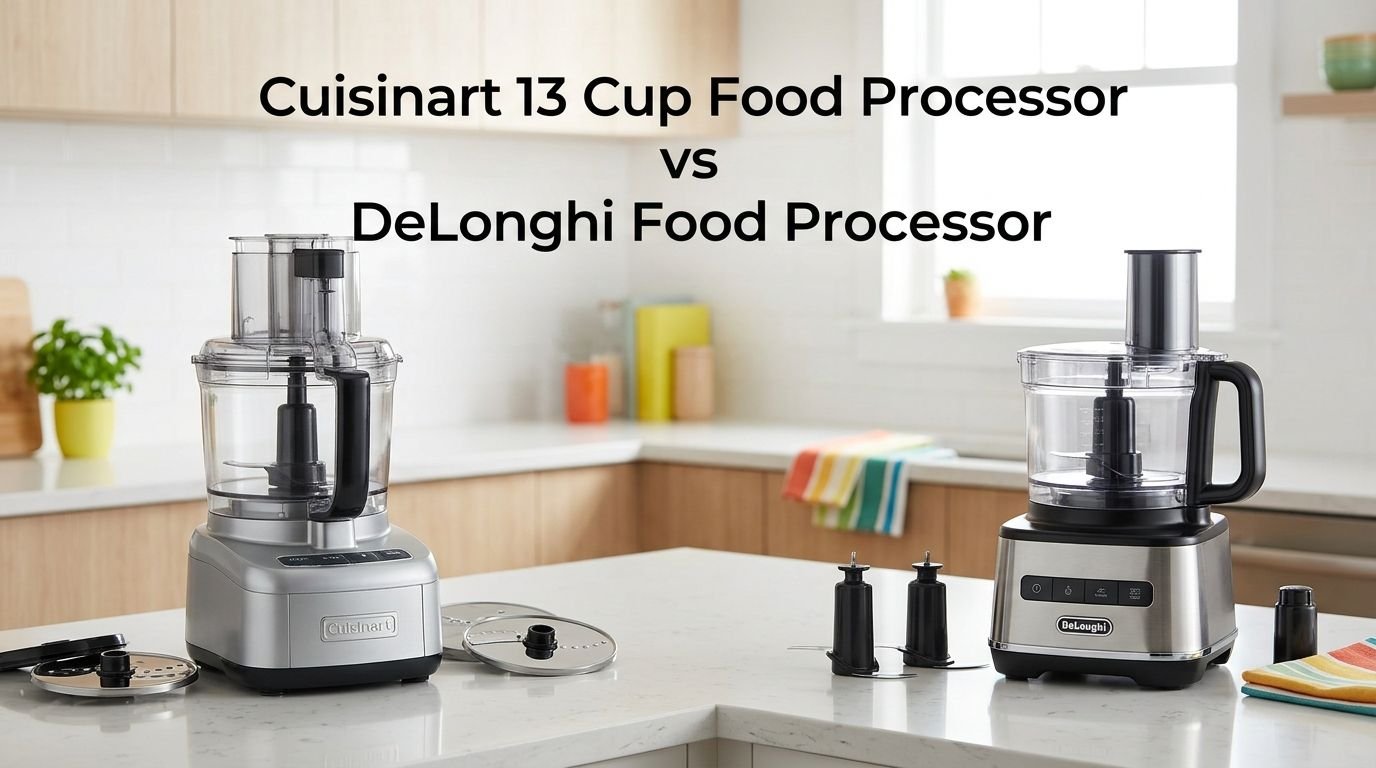
Cuisinart 13 Cup Food Processor vs DeLonghi Food Processor
Choosing a food processor can feel like picking a new kitchen partner. You want something reliable, powerful, and ready for any recipe you throw at it. T
wo popular names keep popping up in this category: Cuisinart and DeLonghi. Both brands have earned loyal followings, but they offer very different experiences.
The Cuisinart 13 Cup Food Processor has long been a favorite among home cooks and professionals alike. It delivers consistent performance with a generous bowl capacity.
Key Takeaways
- The Cuisinart 13 Cup Food Processor (FP-13DSV or FP-1300) offers a large 13 cup work bowl that handles big batch cooking with ease. It is ideal for families or anyone who preps meals in advance.
- DeLonghi food processors tend to focus on compact design and multi-function capability. They often include blender attachments and multiple speed settings in a sleek package.
- Motor power matters for tough tasks like kneading dough or shredding hard vegetables. Cuisinart typically delivers 550 to 750 watts, while DeLonghi models vary between 500 and 750 watts depending on the model.
- Blade and disc variety can save you money on extra accessories. Cuisinart includes a stainless steel S-blade, shredding disc, and slicing disc as standard. DeLonghi often bundles similar accessories but may add a blender jar.
- Ease of cleaning is a major factor for daily use. Both brands offer dishwasher safe parts, but bowl design and lid mechanisms differ significantly.
- Price and long term value should guide your final decision. Cuisinart models in the 13 cup range typically fall between $100 and $200, while DeLonghi food processors sit in a similar bracket depending on features.
Cuisinart 13 Cup Food Processor: An Overview

The Cuisinart 13 Cup Food Processor (model FP-130) is a kitchen workhorse built for serious home cooks. It features a 950 watt motor that powers through tough ingredients like hard cheese, root vegetables, and dense doughs. The 13 cup BPA free Tritan work bowl gives you room to process large batches of salsa, hummus, or pie dough in a single go.
Cuisinart has been a leader in the food processor space for decades. This model continues that tradition with simple lever controls and four speed options. You get a standard S-blade for chopping and pureeing, a reversible shredding disc, and a slicing disc. These stainless steel accessories handle everything from grating Parmesan to slicing cucumbers paper thin.
The machine measures approximately 15.3 inches deep, 10.3 inches wide, and 19.7 inches tall. It fits comfortably on most kitchen counters without dominating the space. The wide feed tube allows you to push whole fruits and vegetables through without much pre-cutting. This saves time during meal prep and reduces frustration.
Pros:
- Large 13 cup capacity handles big batches
- Powerful 950 watt motor tackles tough ingredients
- BPA free Tritan work bowl is durable and safe
- Includes multiple stainless steel blades and discs
- Simple lever controls with four speeds
Cons:
- Heavier unit takes up counter space
- Can be loud at higher speeds
- Higher price point than smaller models
DeLonghi Food Processor: An Overview

The DeLonghi DFP250 is a 9 cup food processor that doubles as a blender. This dual function design makes it a unique choice for smaller kitchens. It runs on a 400 watt motor and includes a patented dual drive system. This system adjusts rotation and power depending on whether you use the food processor bowl or the blender carafe.
DeLonghi packs several accessories into the box. You get a serrated stainless steel chopping blade, a dough tool, two reversible slice and shred discs (thick and fine), and a 40 ounce blender carafe. The blender attachment sits on the same base, so you can switch between functions without needing a separate appliance.
The unit is compact at only 14 inches tall, 7.87 inches wide, and 7.87 inches deep. It weighs just 8 pounds, making it easy to store and move around. The dial control offers two speeds plus a pulse function. Cord storage on the base keeps your counter tidy.
Pros:
- Dual function: food processor and blender in one
- Compact and lightweight design saves space
- Includes thick and fine reversible discs
- BPA free work bowl
- Affordable price point
Cons:
- Only 400 watts of motor power
- Blender carafe is plastic, not glass
- Struggles with hard cheeses and crushing ice
- Smaller 9 cup bowl limits batch size
Motor Power Comparison
Motor power directly affects how well a food processor handles difficult tasks. The Cuisinart FP-130 delivers 950 watts of power. This is more than double the DeLonghi’s 400 watt motor. That extra wattage translates to smoother purees, faster chopping, and better performance with hard ingredients.
The DeLonghi compensates somewhat with its dual drive system. This technology adjusts the rotation speed and torque based on the attachment you use. It helps the motor work more efficiently, but physics still applies. A 400 watt motor will struggle with tasks that a 950 watt motor handles easily.
If you regularly process hard cheeses like Parmesan, knead bread dough, or shred raw beets, the Cuisinart will perform significantly better. The DeLonghi works fine for softer fruits, cooked vegetables, and basic chopping tasks. Think about the hardest ingredients you plan to process before making your decision.
For casual cooks who mostly chop onions and make simple sauces, the DeLonghi’s motor is sufficient. For avid home chefs who tackle complex recipes, the Cuisinart’s power advantage makes a real difference in daily use.
Bowl Capacity and Size
The Cuisinart offers a 13 cup work bowl while the DeLonghi provides a 9 cup bowl. That 4 cup difference matters more than you might think. A larger bowl lets you process entire recipes in one batch. A smaller bowl forces you to work in multiple rounds for bigger recipes.
The DeLonghi’s 9 cup rating refers to dry ingredient capacity. For thick liquids, the practical capacity drops to about 4 cups. For thin liquids, it falls to approximately 2.5 cups. The Cuisinart’s 13 cup bowl handles significantly more liquid before any risk of leaking.
Families of four or more will appreciate the Cuisinart’s extra room. Making a large batch of soup base, shredding cabbage for coleslaw, or mixing cookie dough for a crowd all benefit from that larger bowl. Singles and couples who cook smaller portions may find the DeLonghi’s capacity perfectly adequate.
Both bowls are BPA free, which is important for health conscious cooks. The Cuisinart bowl is made from Tritan plastic, known for its durability and resistance to cracking. The DeLonghi bowl is also BPA free plastic but some users have noted it feels less sturdy.
Blades and Accessories Included
The accessories that come with a food processor determine its versatility right out of the box. Cuisinart includes a stainless steel S-blade for chopping and pureeing, a reversible shredding disc, and a slicing disc. These three attachments cover the most common food prep tasks.
DeLonghi includes a serrated stainless steel chopping blade, a dough tool, a thick slice and shred disc, and a fine slice and shred disc. The DeLonghi gives you four reversible surfaces compared to Cuisinart’s two. That means more slicing and shredding options without buying extras.
DeLonghi also throws in the 40 ounce blender carafe as a standard accessory. This adds smoothie making and liquid blending to your tool set. Cuisinart does not include a blender attachment, though some Cuisinart models in the Elemental line add a spiralizer.
DeLonghi offers optional accessories you can purchase separately. These include a twin beater geared whisk, a rasping disc for hard cheese, and a geared citrus press. Cuisinart has a wider ecosystem of compatible accessories available for purchase. Both brands let you expand functionality over time, but Cuisinart’s larger range of accessories gives it an edge for long term versatility.
Ease of Use and Controls
The Cuisinart FP-130 uses lever controls with four speed settings. You push the lever to select your speed. This design feels intuitive. Most users report they can operate the machine without reading the manual. The wide feed tube accepts larger pieces of food, which reduces prep time.
The DeLonghi DFP250 uses a dial control with two speeds plus pulse. Speed 1 is for soft fruits and vegetables. Speed 2 is for blending, dough making, and whisking. The pulse function works in short bursts to give you control over texture. The controls are simple but offer less precision than the Cuisinart’s four speeds.
Assembly and disassembly differ between the two. The Cuisinart follows a traditional food processor setup: bowl locks onto the base, blade drops in, lid twists on. The DeLonghi adds the step of choosing between the food processor bowl and blender carafe, which requires swapping attachments on the same base.
Both machines have interlocking safety systems. The motor will not start unless the lid and bowl are properly secured. This feature prevents accidental injuries and is standard on quality food processors. Neither machine is difficult to use, but the Cuisinart’s extra speed options and larger feed tube give it a slight advantage for daily convenience.
Cleaning and Maintenance
Nobody wants to spend 20 minutes cleaning a food processor after using it for 5 minutes of food prep. The Cuisinart’s parts are dishwasher safe, including the work bowl, lid, and blades. You can also hand wash them with warm soapy water and a brush.
DeLonghi recommends hand washing the work bowl and cover, as well as the blender carafe. This is a notable difference for busy cooks who rely on the dishwasher. Hand washing adds extra time and effort after every use. Some users ignore this recommendation and place the parts in the dishwasher anyway, but DeLonghi does not officially support this.
The Cuisinart’s bowl design has fewer crevices where food can get trapped. The DeLonghi’s blender carafe has the blade permanently fixed to the bottom, which makes it harder to clean around. A long bottle brush helps, but it is still more effort than the Cuisinart’s simple removable blade design.
Both machines benefit from rinsing parts immediately after use. Dried on food is harder to remove from any food processor. Keep the motor bases dry and wipe them with a damp cloth. Neither base should ever be submerged in water.
Design and Build Quality
The Cuisinart FP-130 looks like a classic food processor. It comes in white, stainless steel, and other color options depending on the exact model variant. The build feels solid and heavy. That weight provides stability during operation, so the machine does not walk across your counter.
The DeLonghi DFP250 has a sleek stainless steel finish that adds a modern touch to any kitchen. It is significantly lighter at only 8 pounds compared to the Cuisinart’s heavier frame. The compact footprint means it takes up less counter space and stores more easily in cabinets.
Build quality leans in Cuisinart’s favor based on user feedback. The Tritan work bowl feels thick and durable. The base has a solid feel. DeLonghi’s plastic components have received mixed reviews, with some users describing them as feeling thinner than expected. The DeLonghi’s metal base is well centered and includes suction cups for stability.
Both machines look good on a countertop. The Cuisinart suits kitchens with a traditional or professional aesthetic. The DeLonghi fits modern and minimalist kitchens where space savings matter most. Your personal style preference may play a role in this decision.
Performance with Dough
Bread bakers and pastry enthusiasts should pay close attention to dough performance. The Cuisinart’s 950 watt motor kneads dough efficiently. The large 13 cup bowl gives dough room to develop without overflowing. You can make multiple loaves worth of bread dough in a single batch.
The DeLonghi includes a dedicated dough tool, which is a nice touch. However, its maximum dough capacity is only 12 ounces. That equals roughly 1.5 cups or one small loaf of bread. If you want to make larger batches, you must run the machine multiple times. The 400 watt motor also works harder with stiff dough, which can shorten the motor’s lifespan over time.
For occasional small batch dough making, the DeLonghi works fine. For regular bread baking or making large quantities of pizza dough, the Cuisinart is the clear winner. The extra power and capacity make a significant difference in dough quality and convenience.
Both machines produce acceptable dough when used within their recommended limits. The key is matching your baking habits to the machine’s capabilities. If you only make dough a few times a month in small amounts, the DeLonghi handles the job. If dough is a weekly routine, invest in the Cuisinart.
Price and Value for Money
The Cuisinart FP-130 typically retails between $100 and $170 depending on the color and retailer. This price point sits in the mid range for 13 cup food processors. You get strong motor power, a large bowl, and reliable accessories for that investment.
The DeLonghi DFP250 often sells for under $90, making it the more budget friendly option. The included blender attachment adds value since you effectively get two appliances for the price of one. If you are on a tight budget, the DeLonghi offers impressive functionality per dollar spent.
However, value goes beyond the initial price tag. The Cuisinart’s stronger motor and larger capacity mean it may last longer under heavy use. Replacement parts for Cuisinart are widely available and reasonably priced. DeLonghi replacement parts can be harder to find depending on your location.
Consider your cooking frequency and intensity. A casual cook who uses a food processor once or twice a week will find excellent value in the DeLonghi. A serious home cook who relies on a food processor daily should view the Cuisinart as a worthwhile investment. The extra money buys durability and performance that pays off over years of use.
Noise Levels
Food processor noise can range from tolerable to headache inducing. The Cuisinart FP-130 is not a quiet machine, especially at higher speeds. The powerful 950 watt motor generates noticeable noise during operation. Users report it is comparable to other full size Cuisinart models.
The DeLonghi DFP250 runs quieter at lower speeds thanks to its smaller 400 watt motor. Less power means less noise in most cases. However, when the motor strains against hard ingredients, the noise level increases and can sound strained.
Neither food processor qualifies as whisper quiet. If noise is a major concern, consider processing during non-nap times or using the pulse function in short bursts. The Cuisinart’s noise comes with confidence because the motor easily handles tough tasks. The DeLonghi’s noise during heavy loads can sometimes signal the motor is working beyond its comfortable range.
For early morning or late night cooking, both machines will be heard. The DeLonghi has a slight advantage during light tasks. The Cuisinart’s noise feels more proportional to its power output and rarely sounds like the motor is struggling.
Warranty and Customer Support
The Cuisinart FP-130 comes with a 3 year limited warranty. Cuisinart has a strong reputation for customer service. Replacement parts are easy to order through their website or Amazon. The brand has been in the food processor business since the 1970s, so support infrastructure is well established.
DeLonghi offers a 1 year limited warranty on the DFP250. The shorter warranty period reflects the lower price point but may concern buyers who want long term protection. DeLonghi’s customer support is generally responsive, but finding specific replacement parts for older models can be challenging.
Warranty length should factor into your decision, especially if you plan to use the food processor heavily. A 3 year warranty gives peace of mind. A 1 year warranty means any issues after the first year become your responsibility financially.
Both brands honor their warranties through standard return and repair processes. Keep your receipt and register your product online for the smoothest warranty experience. Extended warranties from retailers are also an option if you want additional coverage on either machine.
Which Food Processor Should You Buy?
The answer depends on your kitchen needs, cooking habits, and budget. Choose the Cuisinart 13 Cup Food Processor if you cook for a family, process hard ingredients regularly, knead dough often, or want a machine that handles heavy daily use. Its superior motor power and larger bowl make it the better workhorse.
Choose the DeLonghi DFP250 if you have a small kitchen, cook for one or two people, want a combined food processor and blender, or need to stay under a strict budget. Its compact design and dual functionality offer great value for lighter cooking needs.
Both machines are solid choices in their respective categories. The Cuisinart excels at pure food processing power and capacity. The DeLonghi wins on versatility and space efficiency. Neither machine will disappoint you if you match it to your actual cooking requirements.
Think honestly about how you cook today and how you want to cook tomorrow. If your ambitions are growing toward bigger meals and more complex recipes, the Cuisinart positions you well for that growth. If simplicity and space savings are your priorities, the DeLonghi delivers exactly what you need.
Frequently Asked Questions
Is the Cuisinart 13 cup food processor dishwasher safe?
Yes, the Cuisinart FP-130 has dishwasher safe parts including the work bowl, lid, and blades. The motor base should only be wiped clean with a damp cloth and should never be submerged in water. Always check the user manual for specific care instructions for your model variant.
Can the DeLonghi food processor crush ice?
The DeLonghi DFP250 struggles with crushing ice due to its 400 watt motor. Users report that it does not crush ice effectively through the blender attachment. If ice crushing is important to you, a dedicated blender or a food processor with a more powerful motor would serve you better.
How loud is the Cuisinart 13 cup food processor?
The Cuisinart FP-130 produces noticeable noise, similar to most full size food processors with 950 watt motors. It is louder than the DeLonghi during standard operation but handles tasks more efficiently. Shorter processing times can offset the higher noise level.
Does the DeLonghi food processor come with a dough blade?
Yes, the DeLonghi DFP250 includes a plastic dough tool for making yeast based dough. However, the maximum dough capacity is only 12 ounces, which produces roughly one small loaf of bread per batch. Larger dough quantities require multiple processing rounds.
Which food processor is better for meal prepping?
The Cuisinart 13 cup food processor is better for meal prepping due to its larger bowl and stronger motor. You can process bigger batches of vegetables, sauces, and doughs without stopping to empty the bowl. The DeLonghi works for smaller meal prep sessions but requires more batches for the same volume.
Can I buy extra accessories for both food processors?
Yes, both Cuisinart and DeLonghi sell additional accessories separately. Cuisinart has a wider selection of compatible discs and blades available through their website and major retailers. DeLonghi offers optional attachments like a whisk, rasping disc, and citrus press, though availability may vary by location.