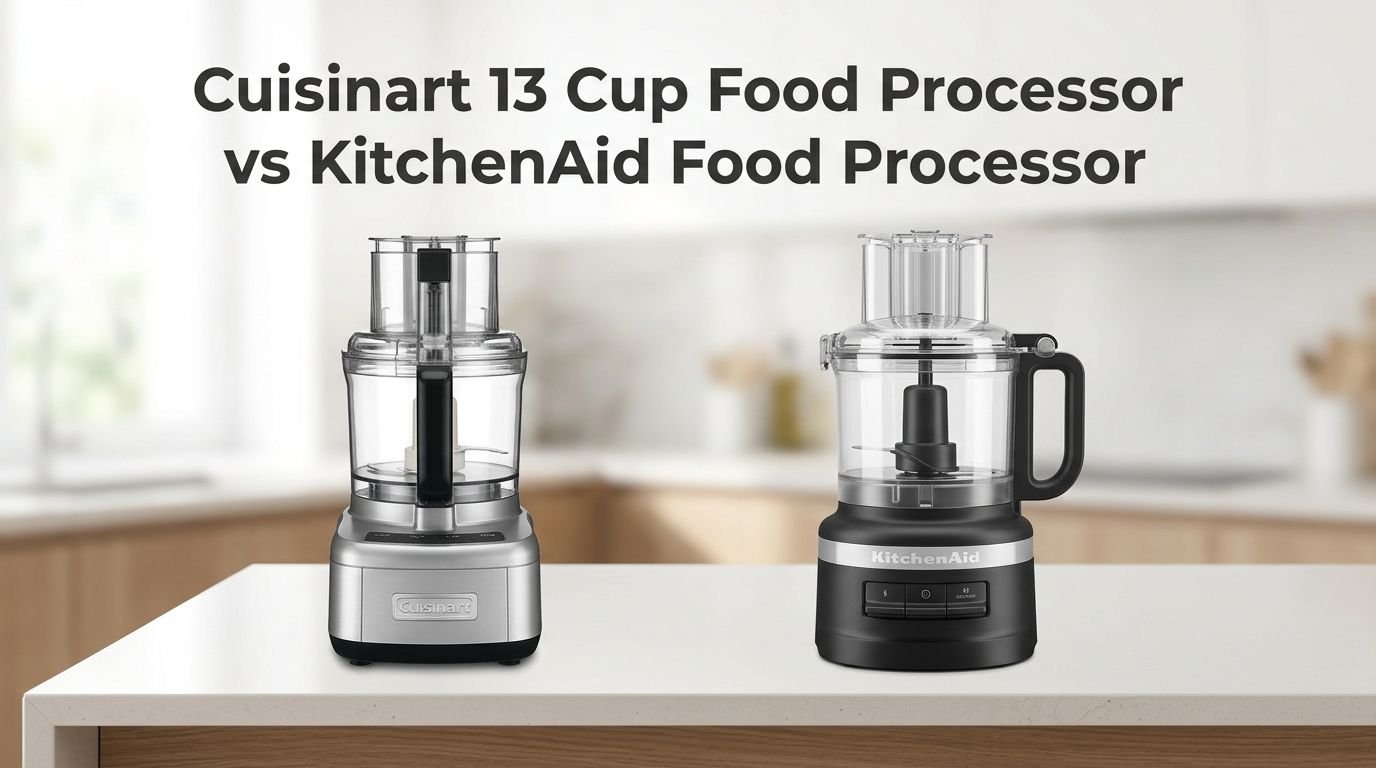
Cuisinart 13 Cup Food Processor vs KitchenAid Food Processor
Picking a food processor feels like a big deal because it should be. This one machine can chop, slice, shred, knead, and puree everything you throw at it.
Two brands dominate this space: Cuisinart and KitchenAid. Both have earned their spot on kitchen counters around the world. But which 13-cup model actually deserves your money?
In this head-to-head comparison, we break down the Cuisinart 13 Cup Food Processor (FP-130) and the KitchenAid 13 Cup Food Processor (KFP1318).
Key Takeaways:
- The Cuisinart FP-130 packs a 650-watt motor, which gives it a significant edge for heavy tasks like kneading dough and shredding hard cheeses. The KitchenAid KFP1318 uses a 500-watt motor, which is still capable but less powerful overall.
- KitchenAid offers three speed options (low, high, and pulse), while the Cuisinart provides a simpler on/off and pulse setup. If you want more control over texture and consistency, KitchenAid gives you that flexibility.
- Both processors hold 13 cups of food, making them suitable for families of four to six people. They can handle large batches of salsa, hummus, pie dough, and shredded vegetables with ease.
- KitchenAid features an UltraTight Seal system that prevents leaks and spills during processing. This is a real advantage if you work with liquids, soups, or thin batters. The Cuisinart does not have a comparable leak-proof seal.
- Cuisinart offers a longer warranty period with a three-year limited warranty and five years on the motor. KitchenAid provides a standard one-year warranty on its 13-cup model.
- Price-wise, both machines sit in a similar range, but the Cuisinart often edges out as the better value because of its stronger motor and longer warranty.
Cuisinart 13 Cup Food Processor Overview

- New motor platform enables this versatile food processing system to offer variety of functions...
- Basic Accessories: Chopping Blade, Fine and Medium Reversible Slicing and Shredding Discs
Last update on 2026-07-21 / Affiliate links / Images from Amazon Product Advertising API Some of the links on this website are affiliate links, which means that at no additional cost to you, I earn a commission if you click through and make a purchase. I only recommend products and services that I believe will add value to my readers. Thank you for your support!
The Cuisinart Core Custom FP-130 is a 13-cup food processor built for home cooks who need serious power without a commercial price tag. It runs on a 650-watt motor that handles everything from soft fruits to dense bread dough.
The work bowl is made from BPA-free Tritan plastic, which is both durable and shatter-resistant. It comes with a stainless steel S-blade for chopping, a reversible shredding disc, and a slicing disc. The large feed tube fits whole fruits and vegetables, so you spend less time cutting things down to size before processing.
Cuisinart has been making food processors since the 1970s. The brand essentially introduced the food processor to American kitchens. That history shows in the FP-130’s design. The controls are straightforward: a simple lever system that lets you switch between functions quickly. There is no learning curve here. You plug it in, lock the bowl, and start processing.
Pros:
- Powerful 650-watt motor handles tough ingredients
- 13-cup Tritan work bowl is durable and BPA-free
- Simple lever controls for easy operation
- Extra-large feed tube accepts whole fruits
- Three-year warranty with five years on the motor
- Lightweight and compact footprint
Cons:
- No leak-proof seal system; can overflow if overfilled
- Lid fit can sometimes feel finicky
- Only two speed settings (on and pulse)
- Feed tube and pusher assembly can be confusing at first
KitchenAid 13 Cup Food Processor Overview

- All-in-one storage solution to store all blades and discs directly in the in-bowl storage caddy.
- Easily adjust slicing thickness with the externally adjustable Exact Slice disc, from thick to thin.
Last update on 2026-07-21 / Affiliate links / Images from Amazon Product Advertising API Some of the links on this website are affiliate links, which means that at no additional cost to you, I earn a commission if you click through and make a purchase. I only recommend products and services that I believe will add value to my readers. Thank you for your support!
The KitchenAid KFP1318 is a 13-cup food processor that brings the brand’s signature style and thoughtful design to your countertop. It uses a 500-watt motor with three speed settings: low, high, and pulse. This gives you more control over how finely or coarsely your food gets processed.
KitchenAid’s standout feature is the ExactSlice system. This external lever lets you adjust slicing thickness from thin to thick without opening the processor or changing discs. It saves time and gives you a level of precision that most food processors cannot match.
The processor also includes the UltraTight Seal lid system. A specially designed locking mechanism and leak-proof ring keep liquids inside the bowl, even at full capacity. If you frequently make soups, dressings, or thin batters, this feature alone might win you over.
KitchenAid offers the KFP1318 in multiple color options, including Onyx Black, Contour Silver, Empire Red, and White. The brand understands that kitchen appliances are also design statements.
Pros:
- Three speed settings offer more processing control
- ExactSlice system for adjustable slice thickness
- UltraTight Seal prevents leaks and spills
- Available in several attractive color options
- BPA-free work bowl and lid
- Quiet operation compared to many competitors
Cons:
- Lower 500-watt motor can struggle with very dense ingredients
- May overheat during extended heavy-duty use
- Slightly more expensive than the Cuisinart
- One-year limited warranty is shorter than Cuisinart’s
- Plastic body feels somewhat lightweight
Motor Power and Performance
Motor power is one of the most important factors in choosing a food processor. It determines what the machine can handle and how quickly it gets the job done.
The Cuisinart FP-130 delivers 650 watts of processing power. This is enough to knead bread dough, shred hard blocks of cheese, and crush ice without hesitation. The motor runs strong and consistent, even under heavy loads. Users rarely report the Cuisinart stalling or overheating during normal use.
The KitchenAid KFP1318 runs at 500 watts. It handles most everyday tasks well, including chopping vegetables, making hummus, and slicing potatoes. But it can struggle with tougher jobs like kneading stiff dough or shredding very firm cheeses. Several user reviews mention the motor heating up during extended heavy-duty sessions.
If your cooking style involves a lot of dough-making, nut butter grinding, or hard cheese shredding, the Cuisinart’s extra 150 watts make a noticeable difference. For lighter, everyday prep work, both processors perform admirably. The KitchenAid’s three-speed system does give you finer control over texture, which can be a fair trade-off depending on your priorities.
Speed Settings and Control
How much control you have over your food processor matters, especially if you cook a variety of dishes that require different textures.
The KitchenAid KFP1318 offers three speeds: low, high, and pulse. The low speed is ideal for gently combining ingredients or making chunky salsas. High speed works for smooth purees, nut butters, and thorough chopping. Pulse gives you quick bursts for coarse textures. This three-tier system gives you real flexibility in the kitchen.
The Cuisinart FP-130 keeps things simpler with just two options: on and pulse. The single processing speed runs at full power, and pulse delivers short bursts. While this setup gets the job done for most tasks, it does lack the nuanced control that the KitchenAid provides. You cannot gently process delicate ingredients at a lower speed.
For home cooks who make a wide range of recipes — from delicate pie crusts to smooth soups — the KitchenAid’s speed options provide a real advantage. If you mostly chop, shred, and slice, the Cuisinart’s straightforward controls keep things simple and fast.
Build Quality and Durability
A food processor should last for years. Build quality directly affects how long your investment pays off.
The Cuisinart FP-130 uses ABS plastic for its housing and a Tritan plastic work bowl. ABS plastic is known for its strength and rigidity. It resists impact well and holds up to years of regular use. The stainless steel blades are thick and durable. Cuisinart backs this build with a three-year warranty and a five-year motor warranty.
The KitchenAid KFP1318 uses polycarbonate plastic for its components. Polycarbonate is slightly more flexible than ABS, which makes it more resistant to cracking under stress. However, it can feel a bit lighter and less substantial in hand. Some users describe the KitchenAid as feeling “plasticky” compared to the Cuisinart. KitchenAid provides a one-year limited warranty.
Both machines have dishwasher-safe parts, which makes cleanup easy. The blades on both models are high-grade stainless steel. In terms of raw durability, the Cuisinart edges ahead due to its sturdier plastic and significantly longer warranty coverage.
Bowl Capacity and Feed Tube Design
Both processors share the same 13-cup capacity, but the feed tubes tell a slightly different story.
The Cuisinart FP-130 features an extra-large feed tube with small, medium, and large pushers. The large opening accepts whole fruits and vegetables. This means you can drop in an entire tomato or a block of cheese without pre-cutting. The nested pusher system lets you choose the right size for different ingredients.
The KitchenAid KFP1318 uses a 2-in-1 feed tube design with a wide mouth. You can use either the large or small opening depending on the ingredient. The design is clean and efficient. The wide mouth feed tube reduces prep time significantly for large ingredients.
In practice, both feed tubes work well. The Cuisinart’s three-size pusher system offers slightly more versatility, but the KitchenAid’s 2-in-1 design is simpler and faster to use. If you regularly process whole fruits and large vegetables, both machines will serve you well. The Cuisinart just gives you one more size option in the pusher.
Noise Level Comparison
Nobody enjoys a food processor that sounds like a jet engine. Noise matters, especially in open-plan kitchens or homes with young children.
The Cuisinart FP-130 runs relatively quietly for a machine with a 650-watt motor. It produces a steady hum during operation. You can still have a conversation nearby without raising your voice. The motor’s efficiency helps keep vibration and noise to reasonable levels.
The KitchenAid KFP1318 is also known for quiet operation. Multiple user reviews highlight how surprisingly quiet it runs compared to other food processors in its class. The 500-watt motor generates less noise naturally, and KitchenAid’s engineering keeps vibrations minimal.
Neither machine will rattle your countertops. If noise is a top concern for you, both processors perform well. The KitchenAid has a slight edge here because its lower-wattage motor naturally produces less sound. But the difference is small enough that most users will not notice it during everyday use.
Included Accessories and Attachments
What comes in the box matters. Extra accessories mean more versatility without additional spending.
The Cuisinart FP-130 includes a stainless steel S-blade for chopping and mixing, a reversible shredding disc (fine and medium), a slicing disc, and the three-piece pusher assembly. The reversible shredding disc is a nice touch because it gives you two shredding options without needing a separate disc.
The KitchenAid KFP1318 comes with a multipurpose blade, a reversible shredding disc, a reversible slicing disc, and a dough blade. The ExactSlice system with external adjustment is also built into the slicing disc setup. Having a dedicated dough blade is a smart inclusion for bakers.
Both machines offer solid accessory packages. The KitchenAid’s dedicated dough blade and ExactSlice system give it an edge for users who bake frequently or need precise slicing. The Cuisinart’s reversible shredding disc and powerful motor make it better suited for heavy shredding tasks. Your choice depends on whether you value precision slicing or raw shredding power.
Ease of Cleaning
Cleaning a food processor should not take longer than the cooking itself. Both brands designed their machines with cleanup in mind.
The Cuisinart FP-130 has dishwasher-safe parts, including the work bowl, lid, and discs. The smooth interior of the bowl makes hand washing quick too. The S-blade removes easily for cleaning. The one downside is the pusher assembly, which has three pieces that need individual washing.
The KitchenAid KFP1318 also has fully dishwasher-safe components. The UltraTight Seal lid disassembles easily for thorough cleaning. The work bowl’s smooth interior wipes clean with minimal effort. The ExactSlice disc is easy to handle and clean thanks to its single-piece design.
Both machines score well on cleaning ease. The KitchenAid’s simpler lid system edges ahead slightly because it has fewer small parts to wash. But the difference is minor. If you own a dishwasher, both processors clean up with virtually no effort.
Design and Aesthetics
A food processor sits on your counter, so it should look good there. Both brands understand this.
The Cuisinart FP-130 comes in White, Stainless Steel, Midnight Blue, and Anchor Gray. The design is sleek and modern with clean lines. The compact footprint means it does not dominate your counter space. The overall look is professional but understated.
The KitchenAid KFP1318 is available in Onyx Black, Contour Silver, Empire Red, and White. KitchenAid has always been a leader in kitchen appliance design. The rounded, smooth body of the KFP1318 looks elegant and inviting. The color options match other KitchenAid appliances, so you can build a coordinated kitchen setup.
If aesthetics rank high on your priority list, KitchenAid has a slight advantage. The brand’s color range and design language are hard to beat. The Cuisinart looks great too, but its design is more functional than fashionable. Both machines are compact enough to leave on the counter permanently without crowding your space.
Warranty and Customer Support
A strong warranty tells you a lot about how much a company trusts its own product.
Cuisinart offers a three-year limited warranty on the FP-130 and an impressive five-year warranty on the motor. This extended motor coverage is rare in the food processor market. Cuisinart’s customer support team is generally well-regarded, with responsive phone and email support. Replacement parts are widely available and affordable.
KitchenAid provides a one-year limited warranty on the KFP1318. This covers defects in materials and workmanship. While KitchenAid’s customer service is professional and helpful, the shorter warranty period means you are on your own sooner if something goes wrong.
The Cuisinart’s warranty package is significantly stronger. If long-term peace of mind matters to you, the Cuisinart’s five-year motor warranty is hard to ignore. This extra coverage can save you money and frustration down the road, especially for a kitchen appliance you plan to use several times a week.
Price and Value for Money
Both food processors sit in a similar price range, typically between $100 and $180 depending on the retailer and color option. The KitchenAid often costs slightly more, especially in popular colors like Empire Red.
The Cuisinart FP-130 offers excellent value. You get a stronger motor, a longer warranty, and reliable performance at a competitive price. The slightly fewer features (no ExactSlice, no UltraTight Seal) are offset by the raw power and durability of the machine.
The KitchenAid KFP1318 justifies its price with premium features like the ExactSlice system, UltraTight Seal, and three-speed control. If these features matter to your cooking style, the extra cost is worth it. You are paying for precision and convenience.
For budget-conscious buyers who want the most powerful machine for their dollar, the Cuisinart wins on value. For buyers who prioritize features, design, and precision, the KitchenAid delivers a premium experience that justifies its slightly higher price tag.
Which One Should You Buy?
The answer depends on how you cook and what matters most to you in the kitchen.
Choose the Cuisinart FP-130 if you need a powerful motor for heavy-duty tasks. It excels at kneading dough, shredding hard cheeses, and processing large batches of dense ingredients. The longer warranty gives you extra confidence in your purchase. It is the better choice for home cooks who value power and durability above all else.
Choose the KitchenAid KFP1318 if you want more control over processing speeds and slice thickness. The ExactSlice system and three-speed settings make it ideal for precise cooking. The UltraTight Seal is a game-changer if you work with liquids regularly. It is the right pick for cooks who value precision and versatility.
Both machines are excellent 13-cup food processors from trusted brands. You will be happy with either one. The key is matching the machine to your specific needs and cooking habits. Think about what you cook most often, and the right choice will become clear.
Frequently Asked Questions
Is the Cuisinart 13 Cup Food Processor Dishwasher Safe?
Yes, the Cuisinart FP-130’s work bowl, lid, pushers, and discs are all dishwasher safe. You should place them on the top rack for best results. The base unit with the motor should never be submerged in water. Simply wipe it down with a damp cloth. Hand washing the S-blade is recommended to keep it sharp longer, though it is technically dishwasher safe.
Can the KitchenAid 13 Cup Food Processor Knead Dough?
Yes, the KitchenAid KFP1318 can knead dough. It even comes with a dedicated dough blade for this purpose. However, its 500-watt motor may struggle with very stiff or dense doughs. For lighter bread doughs, pizza dough, and pie crusts, it works well. For heavy bread doughs, the Cuisinart’s 650-watt motor handles the task more easily.
How Long Do These Food Processors Typically Last?
Both the Cuisinart and KitchenAid food processors are built to last five to ten years with regular home use. Proper care extends their lifespan. This includes not overfilling the bowl, avoiding prolonged continuous runs, and keeping the blades clean and dry. The Cuisinart’s five-year motor warranty provides extra assurance for longevity.
Are Replacement Parts Easy to Find for Both Brands?
Yes, replacement parts are widely available for both Cuisinart and KitchenAid food processors. You can find replacement bowls, lids, blades, and discs on Amazon, the brands’ official websites, and at major retailers. Cuisinart parts tend to be slightly more affordable. Both brands maintain strong parts inventories for their current and recent models.
Which Food Processor Is Quieter?
The KitchenAid KFP1318 is slightly quieter because of its lower-wattage motor. However, both machines operate at reasonable noise levels. Neither one will disturb a conversation in the same room. The difference in noise output is minimal and unlikely to be a deciding factor for most buyers.
Can I Use These Food Processors for Hot Liquids?
You should avoid processing boiling or very hot liquids in either machine. The heat can warp plastic components and create dangerous pressure inside the bowl. Let soups and sauces cool to at least warm temperature before processing. The KitchenAid’s UltraTight Seal offers better protection against spills, but it is not designed for extreme heat either.

Hi, I’m Greta Monroe, and I’m passionate about making every kitchen a place of creativity and efficiency. I’ve spent years exploring and testing kitchen gadgets, tools, and devices to help home cooks find exactly what they need. At ChefKit Blog, I share honest Amazon product reviews and practical insights on kitchen essentials that actually make a difference. From must-have basics to innovative new devices, I break down what works and what doesn’t. My mission is simple: to help you build a kitchen that inspires delicious possibilities every single day.